Smart Contrarians
Smart Contrarians: Thinking Differently about Thinking Differently, coauthored with Balázs Kovács of Yale, is forthcoming from Harvard Business Review Press in Spring 2027 and is now available for pre-order.
Books
Books on thinking differently, learning from noisy evidence, and the role of luck in business and society.
Smart Contrarians: Thinking Differently about Thinking Differently, coauthored with Balázs Kovács of Yale, is forthcoming from Harvard Business Review Press in Spring 2027 and is now available for pre-order.
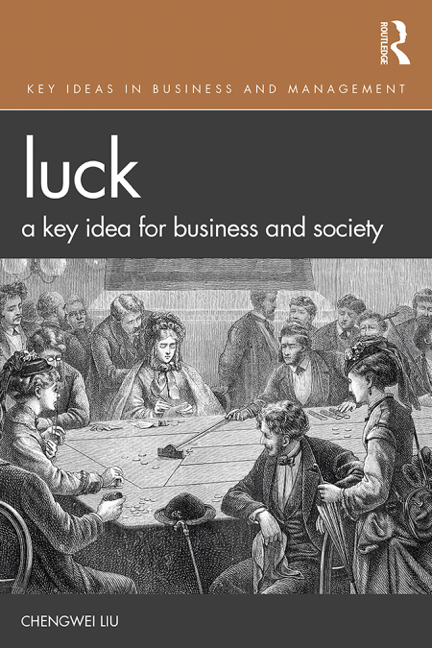
Luck examines how chance shapes success and failure in business, careers, markets, and society. It asks why people so often mistake luck for skill, and what better decisions look like when performance is noisy.
The book develops luck as a practical idea for managers and policymakers: a way to rethink role models, rewards, hiring, investment, inequality, and learning from extreme outcomes.
It was a finalist for the EGOS Best Book Award and has been featured by outlets including the Financial Times, BBC, and Harvard Business Review.
It is hard to problematize the familiar. With familiarity comes lay theories, which are entrenched in the minds of individuals, models which guide and make sense of individual behavior. The concept of luck is familiar to us all yet according to Luck, the word is a stranger to us all. I use it one way and you another. We disagree without ever knowing we do, and so our ignorance is never revealed. Luck has laid bare our ignorance and educates us on the concept of luck. Luck illustrates and explains how luck operates across a number of empirical contexts, highly familiar contexts in themselves. We need to reimagine the colloquialism that it is better to be lucky than good. If we judge research contributions like we judge Olympic dives, Luck receives top marks for degree of difficulty and execution.
Understanding the powerful role of chance in human endeavors may be one of the most profound and revealing insights offered by scholarly study. Liu has written a sophisticated treatise on luck that offers something for everyone, including useful tips and scholarly insights too numerous to count.
We all know that success in business, life, and sports depends in part on luck. But how do we hire, manage, make decisions, and invest in light of that fact? Do we seek out the best, or assume that they were just lucky? Do we fire our worst performers? Do we emulate successful people and organizations? In this surprising, captivating book, Chengwei Liu shows that the answers to these questions depend on the nature and magnitude of luck. We can, in fact, tell whether someone has been lucky or good. You no longer need fear being fooled by randomness. With Chengwei Liu's Luck as a guide, you can become a master of luck. You will learn to identify and quantify luck, and, most important, you will learn some counterintuitive strategies - such as hire the second best, fire the second worst, and never emulate the super successful. Learn this book and you no longer have to choose whether you would prefer to be lucky or good. You can be both!
This book makes for a stimulating read. Written by a wonderfully original researcher, it encourages us to re-examine the prima facie evidence we rely on to make our choices. Moreover, in applying rigorous analysis, the author helps us understand the significance of luck in everyday life and, in doing so, encourages us to take ourselves less seriously.
This book provides a magisterial survey of the concept of luck as well as practical ideas on how one can profit from it, or more precisely from others' beliefs about luck. Academics will find much to provoke thought, and managers will find insights that can help them rethink their strategies and craft new ones. And it is a delightful read for anyone who wishes to be luckier, which is probably all of us.
This highly interesting book takes an often misunderstood concept, luck, and explains how it needs to be interpreted and more importantly, how it can be used effectively in business strategy. The examples are lively and accessible, and the theory is very useful for entrepreneurs, managers, and investors in all fields.
Fortune and chance play big roles in business and economic life in general, yet are often underestimated, as Chengwei Liu points out expertly in his careful and engaging book. What I loved most about Liu's expose is that he takes the notion of luck and explains how it can be managed systematically to your advantage. He shows compellingly that the best strategies are usually those that optimize the odds.
My grandmother taught me that success comes to those who work hard. To which my grandfather replied: and to those who are lucky. Ever since, I wondered about the role of luck in life. This book provides a systematic framework to understand the role luck plays in domains such as sports, financial markets, academic publishing, or firm survival. Combining a diverse set of arguments from behavioral economics, psychology, sociology and statistics, the author argues that luck is more than just a residual, something that we cannot explain, but something that we can measure and exploit for strategic purposes.
This world is full of successful senior executives who are smart, but realize they got lucky. And it is full of others who got lucky, but think they were smart. Read this book and decide which you are.
Liu's book is a fabulous treatment of luck, and is filling a much-needed gap for managers and management scholars. Every manager interested in discerning whether decision outcomes are the product of luck or skill should read it. As should every scholar or manager needing a structured treatment of luck and how it might be used strategically. His insights are paradoxical.
An insightful and highly entertaining tour of the counter-intuitive world of luck, skill, praise and blame, by one of its leading researchers.
To be lucky or not to be lucky, that's a mathematical as well as a behavioural question. This book challenges the conventional wisdom of luck and shows that luck not only has five different images, but also can be measured for its impacts or used for plotting strategic moves. If you believe that luck is something that cannot be manipulated, you need to prepare to change your mind. The book of Luck will tell you a rather different story of chance. This book will not give you luck, but you may know how to become luckier after reading it.
Luck is a great but largely unacknowledged force in the world of business. Chengwei Liu is a skilled and hugely informed navigator through luck's intriguing labyrinths.
Fabulous behavioural science, explaining why second really is the best and how, by consistently underestimating the role luck plays in success, we undermine our own success. A much needed book that lays bare the truth about luck.
This book is a must read for anyone interested in social systems that produce winners and losers, such as business, athletics and education. It will change the way you think about what the term luck means, and could mean, when we think about social systems. The book tackles fundamental issues of how to use models in the social sciences and offers more nuanced approaches to luck in theory building. It also offers immediately applicable ideas about how business schools could do a better job teaching MBA students in terms of aspirations and realistic understanding of what drives outcomes. This is a highly recommended volume. Although somewhat technically demanding in parts, it is clearly written and will be invaluable for doctoral students and scholars who explore dynamics of competitive systems.